

SG-DOR: Learning Scene Graphs with Direction-Conditioned Occlusion Reasoning for Pepper Plants
Authors:
R. Menon, N. Mueller-Goldingen, S. Pan, GK. Chenchani, M. BennewitzType:
PreprintPublished in:
Arxiv Pre-printYear:
2026Funding:
PhenorobRelated Projects:
Robotics Institute GermanyDOI:
https://doi.org/10.48550/arXiv.2603.06512Links:
BibTex String
@misc{menon2026sgdor,
      title={SG-DOR: Learning Scene Graphs with Direction-Conditioned Occlusion Reasoning for Pepper Plants},
      author={Rohit Menon and Niklas Mueller-Goldingen and Sicong Pan and Gokul Krishna Chenchani and Maren Bennewitz},
      year={2026},
      eprint={2603.06512},
      archivePrefix={arXiv},
      primaryClass={cs.RO},
      url={https://arxiv.org/abs/2603.06512},
}
Abstract:
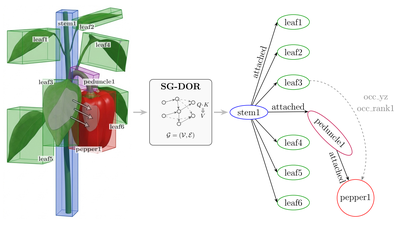
Robotic harvesting in dense crop canopies requires effective interventions that depend not only on geometry, but also on explicit, direction-conditioned relations identifying which organs obstruct a target fruit.We present SG-DOR (Scene Graphs with Direction-Conditioned Occlusion Reasoning), a relational framework that, given instance-segmented organ point clouds, infers a scene graph encoding physical attachments and direction-conditioned occlusion.We introduce an occlusion ranking task for retrieving and ranking candidate leaves for a target fruit and approach direction, and propose a direction-aware graph neural architecture with per-fruit leaf-set attention and union-level aggregation.Experiments on a multi-plant synthetic pepper dataset show improved occlusion prediction (F1=0.73, NDCG@3=0.85) and attachment inference (edge F1=0.83) over strong ablations, yielding a structured relational signal for downstream intervention planning.